Alienation and the Pathology of the Soul: A Philosophical–Psychoanalytic Reading of Chekhov’s Ward No. 6
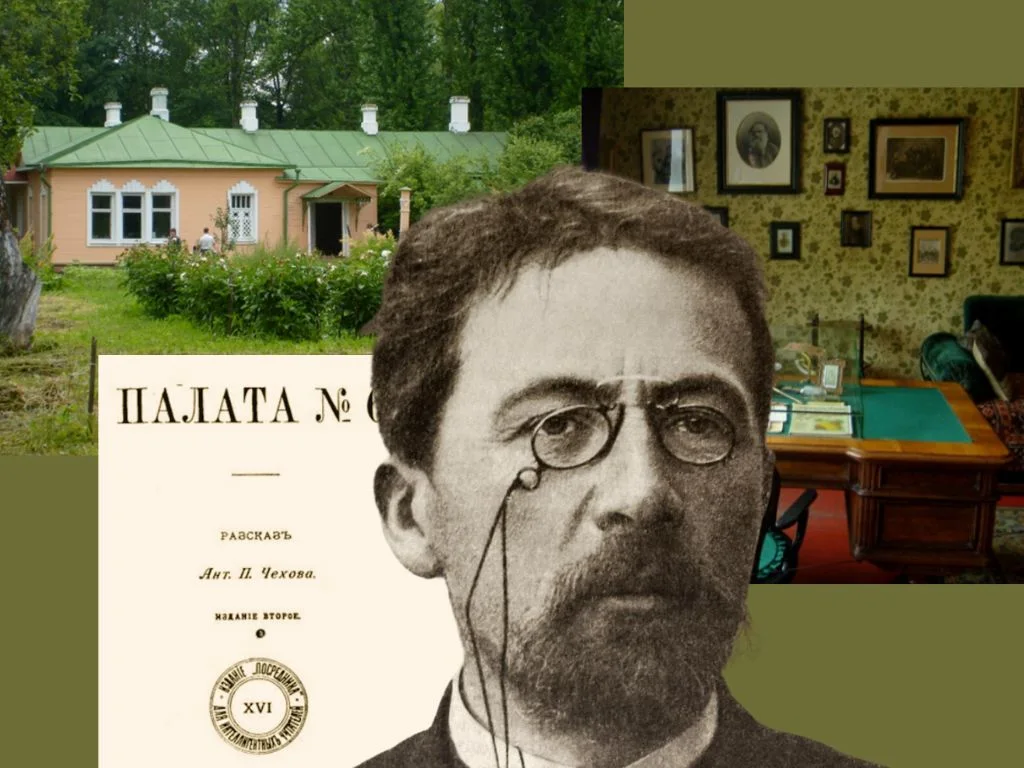
If we read Ward No. 6 not merely as a narrative about a closed institution, but as a complex topography of the human psyche, it transforms into a symbolic space where every figure and every faded wall represents layers of the unconscious that the modern individual does everything to avoid, until life itself forces a confrontation with them. The ward, in this reading, is not simply a hospital structure, but a dark chamber within man, where all the fragile fragments of identity deemed undesirable by culture, morality, and fear are cast away; a place where the nervous system and the social system merge into one, producing a dual mechanism of repression—that of institutional power and that of a censored consciousness.
At the center of this tense universe, Chekhov’s characters can be read as archetypal figures of the crisis of the subject: the doctor who gradually transforms into a patient is not merely a narrative turn, but a profound metaphor for the dissolution of the boundaries between sanity and madness, a reminder that the psychic norm is not an absolute fact, but a fragile construction held together by delicate threads of beliefs, social roles, and rational illusions. Meanwhile, the patient deprived of physical freedom, yet sharp in his spiritual awareness, emerges as a kind of inverted mystic who, liberated from the tyranny of social deceptions, manages to articulate heavy truths that culture refuses to accept, reminding us that madness, in a philosophical sense, can be the most painful form of lucid awareness.
In this constant tension arises the psychoanalytic dimension of the work: the ward becomes the place where the regulated ego confronts the unknown shadows of the self, where the symbolic order collapses, and the individual faces the inverted mirror of logic—a space where, much like in ancient myths, the traveler who descends into it no longer knows whether he is a visitor or a prisoner. This shifting of boundaries, experienced as a transformation of identity, reveals perhaps Chekhov’s darkest idea: that man is never immune to what he denies; that what he sees in "the other" is merely a faded reflection of his own future.
At a deeper philosophical level, Ward No. 6 can be interpreted as a critique of the institutions of modern reason, of the naive belief that society can cleanly separate the sick from the healthy, the acceptable from the unacceptable, as if man were a machine that could be categorized with symmetry and composure. Chekhov, through the sharp contrast between the regulated exterior and the ruined interior, invites us to consider that the social system is nothing more than a grand theater in which we play our roles convinced of our freedom, while at core we are bound to an invisible structure just as constraining as the bars of a psychiatric ward.
Yet the greatest force of the work lies in its ethical dimension: the treatment of the "mad other" mirrors the treatment that civilized man inflicts upon himself. The manner in which society confines, silences, and punishes its most fragile parts is identical to the way the individual denies his own inner conflicts—thus, the ward becomes a dual structure, a space where man is physically discarded, but also a metaphor for the repressed unconscious. This doubling imbues the work with a tragic dimension in which there are no culprits, only victims of a system born out of collective fear toward the inner darkness.
In the end, the narrative opens the most difficult question: is madness a condition, or a mirror? Is it psychic damage, or a cruel revelation? Is the ward a prison, or a laboratory where man sees his bare essence? Faced with these dilemmas, Chekhov’s work becomes a metaphysical meditation on the limits of reason and the tragedy of human existence, which wanders between the desire to know the truth and the deep fear of that which, once known, might destroy it.
If we shift our reading of the ward from a clinical space toward an ontological space, it reveals itself as a stage where man confronts not only the madness of the other, but a stripped-down form of being—a space where all the veils we usually drape over existence to render it bearable disappear. The ward, in this light, resembles those threshold zones that existentialist philosophers called boundary situations: spaces where man collides with the limits of experience itself and is forced to alter his perspective, because he cannot psychologically survive by remaining unchanged.
At this point, contemplating the ward is equivalent to contemplating a fissure in the fabric of reality, a crack through which the light of the collective unconscious falls. Precisely there lies the Foucaultian dimension of the work: the institution of madness is not merely a place of isolation, but an epistemological apparatus that produces the very categories of the normal and the abnormal—a silent mechanism that constantly recycles society’s fears and materializes them in the form of a space where the subject is declared lost. In this sense, the ward is more a consequence of how society thinks than of how the individual falls ill; more a symptom of the social order than a means of cure.
Yet this order is not merely social; it is metaphysical. The characters confined within seem to belong to a world stripped of everyday illusions, a world where linear time loses its meaning and reverts into a heavy, cyclical, almost mythical presence. In the logic of the ward, the experience of time is one of eternal recurrence, where each day resembles the next like a misty reflection of yesterday, creating that suspended state where the subject is neither alive nor dead, but stuck in an intermediate ontological state. This in-betweenness, which can be viewed as a form of liminality, is what makes the ward a powerful metaphor for the crisis of human existence.
In this dimension, the doctor who slips into the very misfortune he once observed from the outside embodies the Heideggerian concept of thrownness (Geworfenheit): man suddenly discovers that he no longer has anywhere to hide his professional distance, prestige, or social role, and that he is just as fragile as those he deemed sick. The erasure of this distinction is not merely a dramatic turn, but a philosophical disruption of the very concept of identity: the individual realizes that the role is merely a garment, beneath which lies a chaotic substance that no institution can fully control.
Here emerges the Jungian dimension of the work: the patients in the ward are projections of the Shadow—the unconscious aspect of the self that both culture and the individual suppress. The ward becomes a vast chamber where the Shadow lives in solidified form, and the visitor who enters confronts not "the madmen," but his own rejected, mud-stained parts. The encounter between the doctor and the patient, from this perspective, is a form of the coniunctio oppositorum (the union of opposites), a moment when identity collapses so that it may be rebuilt at a new level, or vanish entirely.
On the other hand, the character who maintains lucidity inside the psychiatric prison challenges the categories of reason that the age of modernity elevated to absolute status. He manifests the Kierkegaardian concept of the "consciousness of despair": the man who has nothing left to lose manages to see the contradictions of ordinary consciousness far more clearly than he who shelters behind the comforts of normal life. In this sense, it is precisely the one who appears condemned who cultivates a form of inner freedom—a freedom measured not by physical space, but by the capacity to stand face-to-face with one’s truth.
Expanding this reading further, Ward No. 6 can also be situated within the Hegelian dialectic of consciousness, where every form of awareness progresses through conflict with itself. The ward, in this light, is not simply a space of oppression, but the stage where a dialectical drama between master and slave unfolds—a relationship played out not between doctor and patient, but within the modern subject itself. The doctor, who initially appears as the figure of triumphant reason, embodies the "master"—the one who holds the power of knowledge and believes reality can be ordered through ideas and diagnoses. Yet gradually, the Hegelian reversal occurs: he discovers that the stability of his consciousness is illusory, that his position depends on a system he cannot control, and that to know himself he must pass through the very darkness where "the other" resides. The doctor becomes the student of the patient, and the ward transforms into a dialectical laboratory where the subject realizes his freedom is conditioned by what he denies. Thus, madness is not a breakdown of order, but the necessary negative moment through which consciousness gazes into its own depths and transcends the boundaries of its former self.
At this junction, a Nietzschean reading casts new light upon the entire structure. Nietzsche would argue that the ward is where the true face of Dionysus appears—the chaotic, impulsive, wild energy that Apollonian society (with its order, form, and masks) fears to acknowledge. The patients, who seem to have lost contact with rational order, actually carry within themselves a surplus of life, a raw vitality stripped of social hypocrisy. Meanwhile, the doctor, representing the sickly morality of bourgeois culture, begins to collapse precisely because the Dionysian forces he had repressed resurface and overwhelm him. His downfall is a tragic turn, but also a liberation: he loses his stance as an observer and plunges into the chaos he once judged—a death of the old man that, for Nietzsche, serves as a prerequisite for the birth of a freer, more powerful consciousness that no longer seeks to hide its instinctive nature. Thus, the ward becomes an arena where idols fall: the idol of absolute rationality, the idol of normality, and the idol of identity itself as something fixed. Every figure there serves as a reminder that man must confront his "inner monster," and that salvation comes not from escape, but from overcoming it.
Yet no work dealing with the fragility of consciousness can escape a Freudian reading. In this dimension, the ward emerges as a pure topography of psychoanalytic structure. Its cold walls can be read as the materialization of the Superego—that external and internal authority regulating behavior, desires, and morality. The patients, on the other hand, embody the Id—the chaotic drives, repressed desires, and unnamed fears that culture has banished from the social stage. The doctor is the regulated Ego attempting to mediate between these worlds, only to discover that his role is impossible: the institutional superego is oppressive, the id of the ward is uncontrollable, and the ego seeking to maintain equilibrium collapses under the weight of internal destruction. The doctor’s slide into madness is a rupture of the repression mechanism, the moment when the cultural mask shatters and the unconscious erupts to the surface. What he sees in the patients is not a pathological state, but a brutal representation of that which was kept locked within himself. The ward, therefore, is neither a prison nor a hospital, but a vast symbolic chamber of the collective unconscious—a space where culture attempts to hide everything that fails to align with its ideal of the healthy human.
It is precisely here that Hegel, Nietzsche, and Freud intersect: all three, each in his own way, emphasize that man is not a complete entity, but a process, an ongoing conflict with himself. Hegel shows us that consciousness matures only through confrontation with negativity; Nietzsche argues that man finds his strength only by embracing the Dionysian impulse; Freud explains that every cultural structure is built upon mechanisms of repression that sooner or later explode. Ward No. 6, through this lens, is the place where these three visions converge: a space where negativity comes to the surface, where the unmasking of identity is inevitable, and where the tensions between impulse and order take visible form.
In the end, Chekhov offers us no resolution. He leaves us before a cracked mirror in which our true face appears fragmented. In this Hegelian–Nietzschean–Freudian mirror, madness turns out to be not a deviation, but a fundamental fact of existence—a dark zone into which man, to survive as a thinking being, must descend from time to time, not to lose himself, but to find himself anew.
At the end of all narratives, Ward No. 6 remains an invisible threshold where man is forced to confront himself not as an idea, nor as a role, but as a bare fact of existence. There, where reality loses its contours and the mind finds nothing left to grasp, emerges that rare space where man encounters his inescapable essence—an essence neither conscious nor unconscious, but something more primary, colder, truer. The ward, in this light, is not a metaphor for madness, but the ultimate test of authenticity: the moment when every mask falls to the ground, leaving only a human being trembling under the weight of his own truth.
This is why entering the ward is always an act of peril: whoever enters never emerges the same. Not because he goes mad, but because he confronts what the outside world hides so zealously: that life is far more fragile than it appears, and the mind itself is a thin bridge over a silent abyss. Chekhov compels us to see that what we call "normality" is nothing more than a temporary pact between our fear and our desire for stability—a pact that shatters the moment one touches the gate of the ward.
And yet, within this dense darkness, there is strangely a kind of light. Not a light of salvation, nor of comfort, but a harsh illumination that grants being a new gravity: the idea that man, despite his fragility, possesses the power to look at himself without illusions. This capacity, at once terrifying and wondrous, is perhaps the only true form of freedom—a freedom born not from evading the darkness, but from the capacity to face it without breaking.
Thus, Ward No. 6 ends not as a story of cruelty, nor as a social critique, but as a quiet metaphysics of fear: a reminder that man always walks beside an invisible abyss, and that his greatness lies not in turning away from that abyss, but in the courage to acknowledge it. Perhaps this is the deepest message of the work: that man is measured not by what he preserves, but by what he dares to see. The ward is the crucible, and whoever passes through it, even if wounded, emerges truer.
In this manner, Chekhov leaves us not with a solution, but with a question even greater than madness itself: what remains of man when all defenses are stripped away? What remains is precisely who we are—not what society expects, nor what we think we ought to be, but a being seeking light even within its own darkness. And right there, in that small moment stripped of all illusion, Ward No. 6 transforms into a text that no longer speaks of madness, but of the silent dignity of human existence.
In that silence, perhaps, man finally recognizes himself.