“The Lost Conscience” by Mikhail Saltykov\-Shchedrin
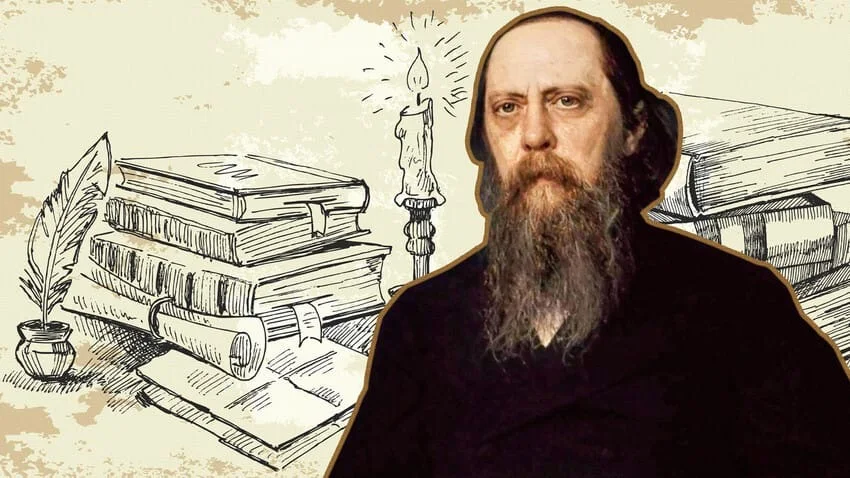
Mikhail Saltykov-Shchedrin is one of the greatest critics of nineteenth-century Russian society. He lived during a period when Russia was undergoing profound political and social changes—from the absolute rule of the Tsar and the deep corruption of the administration to the emergence of debates concerning Russia’s future. He belonged to that generation of writers who, through satire and critical realism, challenged oppression, injustice, and the absence of moral responsibility within society. Among other things, he was one of those writer-thinkers who articulated social and cultural problems through a distinctive literary style.
In The Lost Conscience, Saltykov constructs a narrative that reflects upon the loss of conscience not merely as an individual phenomenon, but as a collective existential condition. In both Russian and Western philosophy, conscience is recognized as a foundation of human freedom and responsibility. When it is extinguished, the human being is transformed into a creature without an inner foundation, without value, and without the capacity to act autonomously and ethically. Thus, the individual becomes detached from the capacity for objective reflection, which de-identifies the external world from the internal one, producing a destabilization of the harmony through which “order” is projected as an ethical semantic structure.
In this sense, conscience is a bridge between the inner self and the external world, a mechanism that sustains responsibility and the sense of justice. When it is lost, the human being becomes alien to himself and to the community, moving toward estrangement (alienation).
Saltykov’s critique constitutes a powerful warning against what philosophers such as Hegel and Marx describe as alienation: the separation of the human being from his existential and social essence. In the Russian society of the time, absolute power and corruption did not merely destroy political structures, but also the human spirit, the reflective capacity of the individual—not only as a being who must preserve his moral essence, but also as its exclusive bearer.
The relation of the moral subject is determined not only by the representative worldviews of a particular ethical current, but also by the particular judgment of phenomena acting within the nature of human and interhuman reality, especially by discourses that produce the ideal that outcomes should be reduced to materialist and pragmatic-utilitarian forms of knowledge directed toward the fulfillment of the individual.
In The Lost Conscience, this condition is represented through diminished and “confused” characters who remain silent and cooperate with injustice in order to preserve their positions and personal interests. This represents a profound disregard for conscience, which subsequently transforms into a “collective sin,” an “anti-heretical freedom.” Saltykov employs satire as a philosophical instrument through which to denounce hypocrisy, corruption, and the absence of responsibility. This form of art possesses particular significance within Russian culture, where writers have often become the critical conscience of society.
In this context, The Lost Conscience is a philosophical reflection on the way in which the absence of conscience leads to the dehumanization of the individual and to the degradation of society as a whole. Satire is not merely mockery, contempt, or ridicule, but a call for reflection and for the expansion of moral consciousness. It represents a masterful and distinctive stage in the articulation of social, political, and cultural problems, the pathways of which sometimes remain unexhausted by simple and classical scientific methods and unexplored through conventional and supposedly self-certain approaches.
Therefore, the suspension of responsibility is not experienced as irresponsibility, but as a postponement and a desirable waiting for the maturation of the conditions necessary to assume full responsibility—an assumption that would lead toward the perfection of decision-making concerning the “duties” of the subject in relation to individuality. The moral relation of the subject to himself ultimately reveals itself as a form of nihilism concealed beneath self-protective mechanisms, which become the subject’s new reality.
Saltykov’s work enters into dialogue with the great traditions of Russian philosophy, which emphasize the importance of the spirit, freedom, and morality for the development of a just society. He refuses to accept a society in which people lose their consciousness, becoming merely instruments of oppressive power. In this way, The Lost Conscience constitutes a warning to every society and every individual who abandons responsibility toward conscience: ultimately, the loss of conscience means the loss of the human being himself.
Mikhail Saltykov-Shchedrin, as one of the most critical voices of nineteenth-century Russia, offers us in The Lost Conscience a profound philosophical mirror of the danger posed by the absence of genuine human conscience. This work is not merely a social critique, but an existential reflection on what makes us human and on how we may lose ourselves when we neglect the moral essence that resides within us.