"The Dream of a Ridiculous Man" by Fyodor Dostoevsky
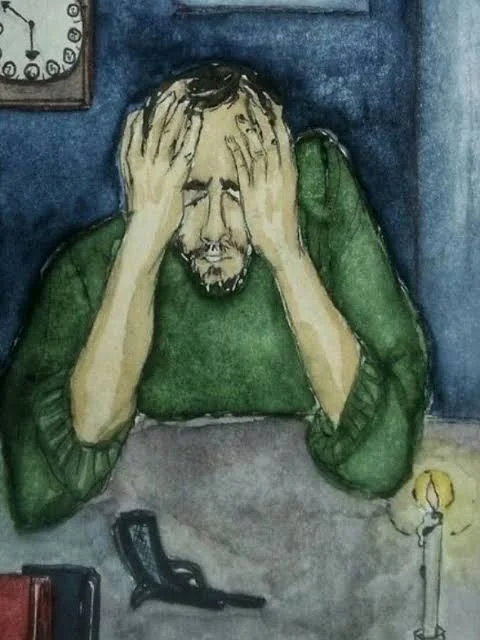
Dostoevsky’s work "The Dream of a Ridiculous Man" is a short fantastic story, first published in April 1877 within the collection "A Writer's Diary".
The text, which opens with a narrator from Saint Petersburg monologuing throughout the work on various themes from a first-person perspective, begins his central preoccupation with the sentence: "I am a ridiculous man." From this entirely subjective position, the character—burdened by his anxieties (Epimeleia Heauton)—continues his existential condition up to the attempt at ending his own life, as nothing any longer holds meaning for him.
In the course of events, the third of November specifically becomes a landmark date for the narrator—that is, for the character-personage, the ridiculous man—which renders his narrative valid and, in synchronization with him, becomes the very catalyst for summoning the courage to kill himself (the moment of illumination).
In this paper, I will attempt to analyze and interpret his efforts from a philosophical perspective, while from a psycho-semantic prism, rationalize his existential condition as a fleeting and "liberating" moment. Likewise, I will address the extension of Dostoevsky's philosophical ideas through literature and the figures presented in the text, specifically focusing on the "content of the dream" as another ontological stage intertwined with existence. For this purpose, I will draw upon contemporary theories as a reference, particularly Markus Gabriel’s work "Neo-Existentialism".
Here is a rigorous, high-level scholarly translation of your paper into English, tailored for academic and philosophical publication.
Mad, Because He Knows the Truth Dostoevsky’s narrative opens with the character-narrator’s explicit statement: “I am a ridiculous man. Now they are calling me mad, too.” From this initial premise—which is so deeply ingrained in the character's psychology that he begins to genuinely internalize these labels, as he subsequently reveals: “Back then I used to be terribly upset because I seemed ridiculous. Or rather, I didn’t just seem so; I was”—he accepts this fait accompli. This acceptance stems from a conscious realization that the label imposed on him by others is a consequence of his pursuit of knowledge, inquiry, and science. His triad of intellectual interests found no room for empathy or comprehension among those around him.
We observe that the character-narrator affirms the status of “the ridiculous man” to himself with the utmost ease in the face of others, as though this characterization originated from an ignorant crowd deserving only pity and compassion for their degraded state.
The sentence, “I would have laughed with them—not so much out of love for them, but because I would not have felt so sad looking at them,” clearly demonstrates a modest hesitation to convince the Other of the truth. In this instance, the character-narrator (the ridiculous man) is deeply convinced that he possesses the truth—a truth that, according to the text, remains inaccessible to others. It is this very truth that has clothed the ridiculous man in his current condition and accompanies him throughout his existential anxieties about the world.
Within these parameters, the character’s psychology is reduced to a stance of defense, the nature of which is fundamentally “quietist”[^1]. The tranquility that had overcome him through the possession of that truth remained not merely a necessity, but also plunged the ridiculous man back into self-doubt and pity for others. His “madness” consists precisely in the fact that others define his ideas under the rubric of the impossible, the ideal, the fantastic, and the imaginary—toward whom he feels only pity and sorrow. This is evidenced by his declaration: “I am sad because they do not know the truth, but I know the truth. Oh, how dreadful it is to be the only one who knows the truth! But they will not understand. No, they will not understand.”
Given the manner in which the problem is framed, there is an urgent need to identify the exact nature of this truth, if only to prevent the character's entire psychological semantics from falling into the trap of psychiatric confinement. Within this context, drawing from the theoretical paradigm of Michel Foucault, the “normals” must be judged in relation to those whom they label as “mad.” As Foucault observes: “People know what they do; frequently they know why they do what they do; but what they don't know is what what they do does”[^2]. Here, it is not directly a question of an idea lacking correspondence with reality, but rather how an idea, once transformed into action, generates a sequence of meanings that must submit to practical reason (Phronesis)[^3].
On this plane, the “normals,” unable to engage in ideal contemplations derived from an a priori causal framework, reject anything that exceeds their cognitive horizon. Conversely, the “mad”—in our case, the ridiculous man—are deeply concerned for them, precisely because the others are bounded and enclosed by dogma, forever incapable of grasping a truth greater than (or different from) their own mundane reality, which is nothing beyond what they immediately live.
In the relationship between the ridiculous man and “the others,” the confrontation at the boundary between knowledge and madness becomes evident. Here, “madness,” having acquired a nominal connotation, is transformed into “the ridiculous.” Among the significant domains delineating this distinction—one that acts not only as the demarcating force but also as the arbiter of their specific contents—is Power.
“We must also cease to believe that knowledge can exist only where the relations of power are suspended, that knowledge can develop only outside its injunctions, demands, and interests. Perhaps one should abandon the belief that power makes mad and that, by the same token, the renunciation of power is one of the conditions of knowledge”[^4]. In the case of the ridiculous man, we are dealing precisely with this dynamic.
In his youth, during his university studies, his entire academic life culminated, according to his own admission, in this realization: “The more I studied, the more I learned that I was ridiculous.” This appears to be a inverted formulation of Socrates’ ancient maxim: “I know that I know nothing.” On one hand, discursive power produced a form of knowledge akin to an Asylum ignorantiae[^5]; on the other hand, the subject’s will to knowledge relied on arguments and facts through which the subject could ascend to an original and authentic state of value—which, in the case of the ridiculous man, fails to materialize as such.
Care of the Self (Epimeleia Heauton) as a Return to Oneself “Whether the world existed or whether there was nothing anywhere, I felt with my whole being that for me it was all the same.” In the concept of the “Care of the Self,” which signifies a return to the subject who produces for himself, attends to himself, and cares for himself, we find in the ridiculous man a “modified care.”
It appears as though nothing can salvage the ridiculous man from his pervasive nihilism, nor from his impulse to care for himself, engage with himself, or treat himself better. Nihilism here is not encountered as a mere reaction, but as his fundamental state—a horizon through which his behavior becomes intelligible, rather than a permanent home he seeks to construct. We frequently find him in a state of profound disorientation: “At first it always seemed to me that a great deal had happened before, but then I realized that there had been nothing before either, only for some reason it had seemed so to me. Gradually I became convinced that there would never be anything either.”
His feeling that whether people existed or not was of no consequence is a direct outcome of his internal demands for truth. In relation to others, this manifested as a denied dimension, the demarcation of which resulted in a sense of utter irrelevance for the ridiculous man, causing all the complex questions lingering in his mind to fade away completely.
His care had effectively inverted into an anti-care: “If we define spirituality as the set of practices that postulate that the subject as he is is not capable of truth, but that the truth as it is is capable of transfiguring and saving the subject, we can say that the modern age of relations between the subject and truth begins on the day when we postulate that the subject as he is is capable of truth, but that truth as it is cannot save the subject”[^6].
The return to oneself manifests as an irreversible condition governing the subject and truth—a fortiori for the ridiculous man. The truth about the subject (the ridiculous man) conditions his truth regarding genuine access to his own spirituality, which had lost all faith.
This unfolds in moments when the truth reveals itself: “And so it was then that I learned the truth. I learned the truth last November, on the third of November, to be precise, and I remember every instant since then.” For Dostoevsky's protagonist, this realization produces a form of exaltation—a locus of satisfaction manifested through a peculiar kind of hostility, personified in his surroundings: “It had been raining all day, a cold, gloomy, sinister rain, a fierce rain, I remember, with an open hostility toward people.” Here we witness an attempt at rehabilitation within the ridiculous man: an anti-moment, an experience of hostility directed at a natural phenomenon—an external projection acting as an internal state, returning as an effect upon the interiority that ought to have been its cause.
On the other hand, we observe the scene where the ridiculous man, en route to his rented room, is approached by a little girl in a thin dress. She grabs him by the coat, pulling him and crying out: “Mamma! Mamma!” He shouts at her to go away, to disappear, adopting the tone of a heartless tyrant devoid of pity or empathy. Yet, as he notes himself: “Nothing mattered to me.” Nevertheless, during his inner monologue, as his dark and hopeless state pressed upon him, he was simultaneously struck by the hammer of consciousness regarding the pain he was inflicting.
As a retroactive function of memory, his bizarre behavior toward the little girl and the subsequent feeling of pity reminded him of a time when not everything was indifferent to him—a time when he was alive and truly existing. This prompts reflections such as: “It was clear to me that if I was a human being and not yet a zero, and as long as I had not turned into a zero, I was alive, and consequently could suffer, be angry, and feel shame for my actions.”
In the self-scrutiny to which the ridiculous man subjects himself during his monologue, we discern a thoroughly solipsistic approach. The aversion to feeling pain over his behavior toward the girl and the world as an existing habitat correlate solely within his own consciousness: “If I were going to kill myself in two hours, for instance, what did I care about the girl, and what did I care about shame or about anything else in the world? I was going to turn into a zero, an absolute zero. Couldn't the consciousness that I was about to cease to exist completely... negate any feeling of pity for the girl or shame for the vileness I had committed?” Does not the ridiculous man whisper between the lines the famous maxim: “The world is my representation”[^7], wherein everything exists merely in my mind and soul? With the extinction of my consciousness, everything ceases—life and the world alike.
In this instance, the ridiculous man is preoccupied with representation as a distinct onto-metaphysical stage. The mere idea of suicide, prior to its translation into an executed act, ought to have extinguished all these feelings of absurdity, since he would no longer have to live with them or carry them as a burden to project his life forward. His anti-care, culminating in suicide, emerges as a modified form of care disguised beneath uncontrolled emotions confronting a refusal to accept them.
Following that visionary moment on his way home—moments before the little girl approached him—when he looked up at the sky and saw a star, a firm conviction took root that he must end his life: “I had bought a fine revolver, too, despite my poverty.” Although he had purchased the revolver two months prior, the moment of illumination was a unification with nature—with the star serving as an affirmative sign that delivered the final verdict on his life.
His monologue deepened into the moral projection of assuming responsibility in the face of the ultimate end, raising eschatological inquiries: If we truly know the end of something—the end of the world, of life, of truth—then what is the purpose of continuing its process?
“The world seemed to exist for me alone; if I shot myself, the world would cease to exist, for me at least. Not to mention that perhaps nothing really would exist for anyone after me, and the whole world, as soon as my consciousness was extinguished, would vanish like a phantom, a mere attribute of my consciousness, because perhaps all this world and all these people were only myself.”
Dream, the New Reality “I dream, therefore I am”[^8]
This would be the apt definition and foundation for a brilliant manifestation of light, highlighting being, time, and the space inhabited by the Dasein of the ridiculous man. Torn between shooting himself in the heart or the head, he chooses the heart. Yet this dilemma is resolved only within the dream: a few minutes before he was to shoot himself, exhausted and satiated, he fell asleep. The new “reality” in which he awoke was not factually new; it was the exact moment he was experiencing his dilemma with the revolver. However, what he could not execute in the “old” reality, he accomplished in his dream.
After dying in the dream, as he watched himself being carried in a coffin to his final resting place—shovel after shovel covering his grave—a poorly defined creature appeared before him: a companion who would take him elsewhere. Dostoevsky takes little care to describe this entity; its role is that of a Charon[^9], extracting the ridiculous man from his grave and transporting him across space to another planet. The ridiculous man’s attempts to converse with it failed; the creature aimed neither for dialogue nor for instruction.
As they approached a star, a meteor, and ultimately a planet, the ridiculous man, in his astonishment, sought to know if this was Earth. “I knew it could not be our sun, which had given birth to our earth, and that we were at an infinite distance from our sun; but I knew with my whole being, somehow, that this was exactly the same sun as ours, a duplicate, a double.”
Even before landing on the new earth, the ridiculous man, enchanted by the cosmos, began to experience new feelings that were, in truth, ancient yet forgotten: “A sweet, rapturous feeling filled my soul: the kindred power of light, of the same light that had given me birth, found an echo in my heart and awakened it to a new life, and for the first time since my burial I felt life within me, the life of former days.”
In his final meditations, as everything crystallized before him—the continents, the oceans, and even the familiar contours of Europe—a strange pang of jealousy suddenly erupted in his heart: “How could such a duplicate exist, and why? I can love only that world which I have left behind, upon which fell the splashes of my blood when I ungratefully extinguished my life with a shot through my heart. And I can love only that world... I have never ceased to love it; indeed, on that night when I parted from it, I loved it more agonizingly than ever. Is there suffering on this new earth? On our earth we can love only with suffering and through suffering; we know no other way to love, and we know no other love. I need suffering in order to love.”
It is as if the remnants of a deep, experiential genesis remained—one of which the ridiculous man had not been sufficiently conscious—compelling him to return to a goodness locked in darkness. Where there is much light, the shadow is deep[^10]. This manifests as a self-narrative experience of the illuminating moment that, within an unfamiliar reality, induces anxiety, fear, and dread. The confrontation with the unknown prompts the act of returning to the known; even in taking his own life, he acknowledges his ingratitude toward his own earth. The desire for suicide is an act of ingratitude toward the world that shaped his worldview, yet a world that bears no blame.
On the new earth, the ridiculous man remained bewildered and amazed as he observed people living happily, joyfully, unburdened, and undefiled. Among them he felt happy, expressing his adoration for that earth, which he kissed on his knees, because they loved the ridiculous man as they loved themselves.
“I kissed the earth they lived on in front of their eyes, and without a word I expressed my profound adoration. They saw this and allowed me to kiss it without shame, because they loved me so much, too.” The ridiculous man kissed the soil as if it were the sole moment in his existence when the entire ridiculousness of his being was taken seriously. The children belonged to everyone; love was the ultimate power and source animating all things. Everything was sufficient; everything was as it ought to be.
Man attains this joyful sense of existence in two states: in dreams and in intoxication[^11]—as two realities originating from the subject's internal state, brought into direct motion with objective reality.
The ridiculous man, shaken by this goodness and absence of guile, asked himself: “How was it that they never hurt a person like me, and never once aroused in me a feeling of jealousy or envy?” In this new world, where the ridiculous man marveled at human nature and the harmony flowing through their veins, there seemed to be no competing 'Other' to fracture a distinct and specific I. It was as though a transcendental I had been systematically injected into every individual.
Reality, Merely a Dream “Can my small heart and my capricious, trivial mind fly to such a revelation of truth? Oh, judge for yourselves: I have kept it a secret until now, but now I want to tell the truth. The point is that I... corrupted them all!”
In the new world, within this human paradise, the ridiculous man had committed the sin of sins. He had corrupted them all: “They learned to lie, they grew fond of lying, and they discovered the beauty of a lie.” Thus, as if in play, through flirtation and jest, it all began with a single tiny atom. And that atomic lie penetrated so deeply into their hearts that it birthed jealousy, and jealousy spawned horror.
“There are no moral phenomena at all, but only a moral interpretation of phenomena”[^12]—this became the maxim to which the ridiculous man reduced this pristine reality. From a nature where morality, honor, virtue, and justice were natural human conditions, everything was inverted. The moment lies and betrayal began to circulate through the capillaries of the human brain, their shared happiness shattered.
Human relationships began to be structured upon the premise Homo homini lupus est[^13]. In their perpetual war of all against all, they forgot how they had once lived; that former existence turned into a myth. They began to suffer, and they came to believe that essence and meaning existed only in suffering; they began to sing hymns to suffering. The ridiculous man began to love these people even more once suffering became part of their world.
While cursing himself, he stretched his hands out to them, judging himself and begging them to crucify him. Lacking the courage to kill himself, he desired that they torture him for the guilt he had brought upon them. But as they listened, they merely laughed at him and viewed him as half-mad. His epithet returned once more: his being had fallen back into its familiar place.
“In the midst of nature, man is always the child in himself. This child may once have a heavy, terrifying dream, but when he opens his eyes he always finds himself in paradise”[^14].
The ridiculous man opened his eyes from his dream. Yet to him, that entire journey was not merely a dream: “Perhaps it was a dream, but it could not be that all this did not actually happen. You know, I will tell you a secret: perhaps it was not a dream at all! For something happened there so terribly real that it could not have been merely dreamed.”
From that new day, returned from this new reality, the ridiculous man pushed the revolver far away from himself. Henceforth, he would live as a herald, a teller of truth, striving to believe in noble human values.
“I cannot and will not believe that evil is the normal condition of human beings. And yet they all laugh at this thought of mine.” Although he will continue until his natural death to believe that evil is not the ordinary state of humanity, this does not diminish the fact that through a dream, his life altered its course. Its content, descended from the “Olympus” of the imagination, is reduced to a true existential condition. “Nothing belongs to you more than your dreams, nothing more than your works”[^15].
The dream is the royal road to our soul[^16], unearthing the paths of our reality; even if they are not true, they can become so. Although Dostoevsky speaks to us in this novella of the state of Adam and Eve on the new earth, this work can also be read as an attempt to give birth to a new human being—an enterprise that, regrettably, failed.
References (Footnotes) [^1]: Quietism (from the Latin quietus – "quiet/tranquil"): Refers to a specific form of Christian mysticism, theology, and asceticism that advocated for the passive tranquility of the soul. [^2]: Foucault, Michel. Wahnsinn und Gesellschaft. Frankfurt am Main: Suhrkamp Verlag, 2015, S. 39. [^3]: Crone, Katja. Über die Seele, Kapitel II: b) Praktische Vernunft. Frankfurt am Main: Suhrkamp Verlag, 2010, S. 39. [^4]: Foucault, Michel. Überwachen und Strafen. Die Geburt des Gefängnisses. Frankfurt am Main: Suhrkamp Verlag, 1976, S. 39. [^5]: Asylum ignorantiae ("Refuge of ignorance"): Seeking refuge in ignorance or resorting to explanations that rely not on scientific arguments and facts, but on something incomprehensible and unknown. [^6]: Foucault, Michel. Hermeneutik des Subjekts. Frankfurt am Main: Suhrkamp Verlag, 2001, S. 37. [^7]: Schopenhauer, Arthur. The World as Will and Representation. [^8]: This maxim should not be viewed as an attempt to articulate existence in the Cartesian sense (Cogito ergo sum) nor in the Berkeleyan sense (Esse est percipi), but should be read through a Neo-Existentialist lens (according to Markus Gabriel), which posits that super-material states (dreams, representations, fictions) possess the same ontological/existential status in so far as they affect and transform the human mind and soul. [^9]: Charon (Χάρων): In Greek and Roman mythology, the ferryman of the Underworld who conveyed the souls of the deceased across the river Acheron/Styx to the realm of Hades. [^10]: Von Goethe, Johann Wolfgang. Götz von Berlichingen mit der eisernen Hand, 1773 (Act I, Götz to Weislingen). [^11]: Nietzsche, Friedrich. Die dionysische Weltanschauung (Nachgelassene Schriften 1870–1873). [^12]: Nietzsche, Friedrich. Beyond Good and Evil. [^13]: Homo homini lupus est ("Man is a wolf to man"): A famous Latin expression widely utilized by Thomas Hobbes to describe the natural state of the war of all against all. [^14]: Nietzsche, Friedrich. Menschliches, Allzumenschliches. Ein Buch für freie Geister, 1878 (Erster Band, Drittes Hauptstück: Das religiöse Leben). [^15]: Nietzsche, Friedrich. Morgenröte. Gedanken über die moralischen Vorurteile, 1881. [^16]: Freud, Sigmund. Die Traumdeutung, 1899 (Where the dream is described as the Via Regia or royal road to the unconscious).